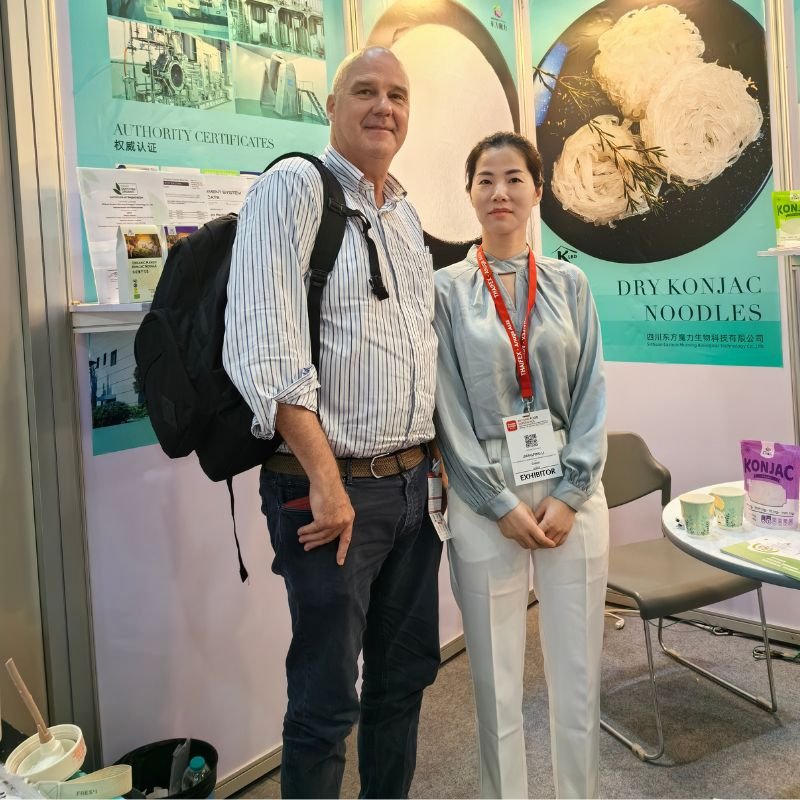
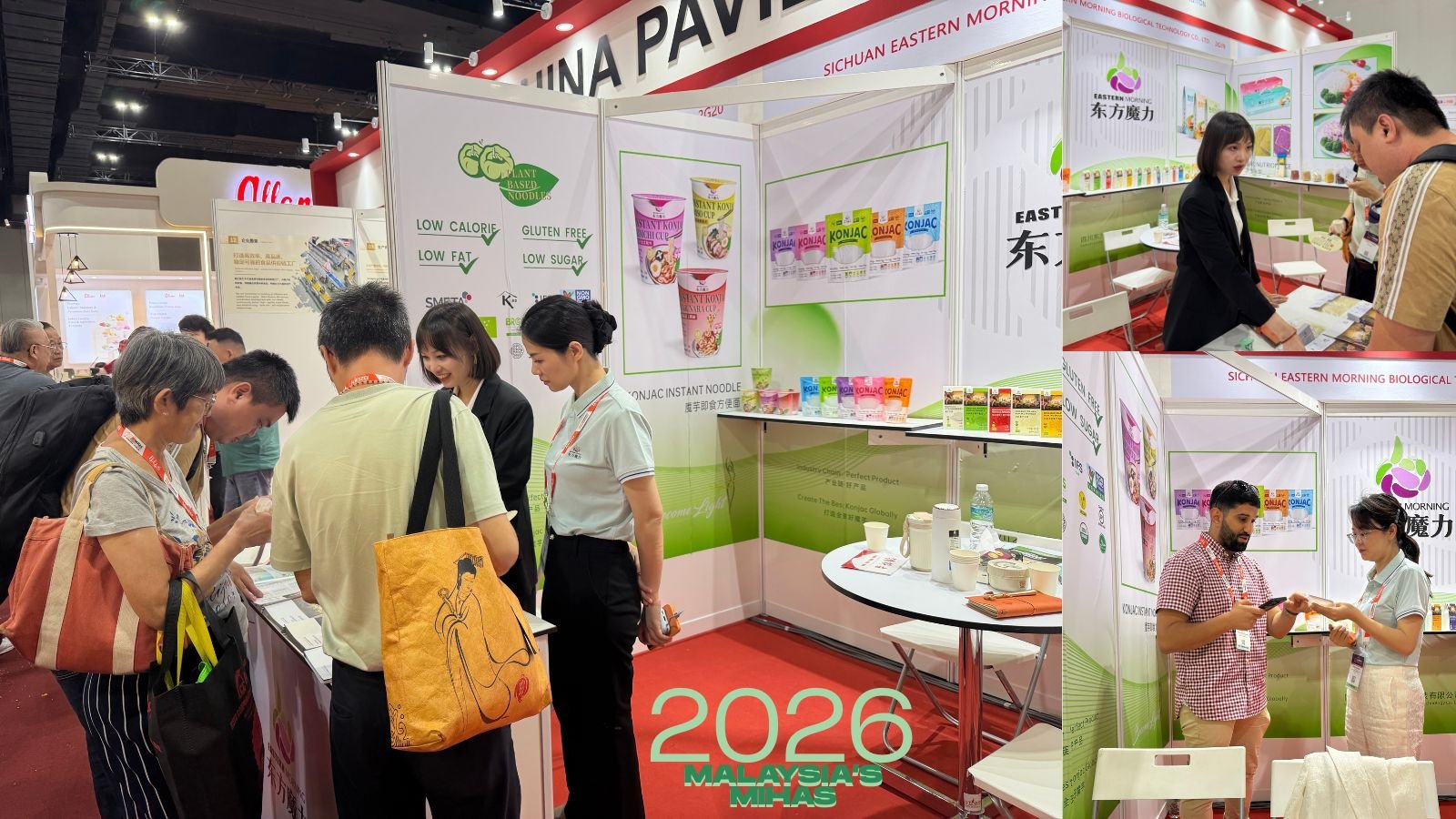
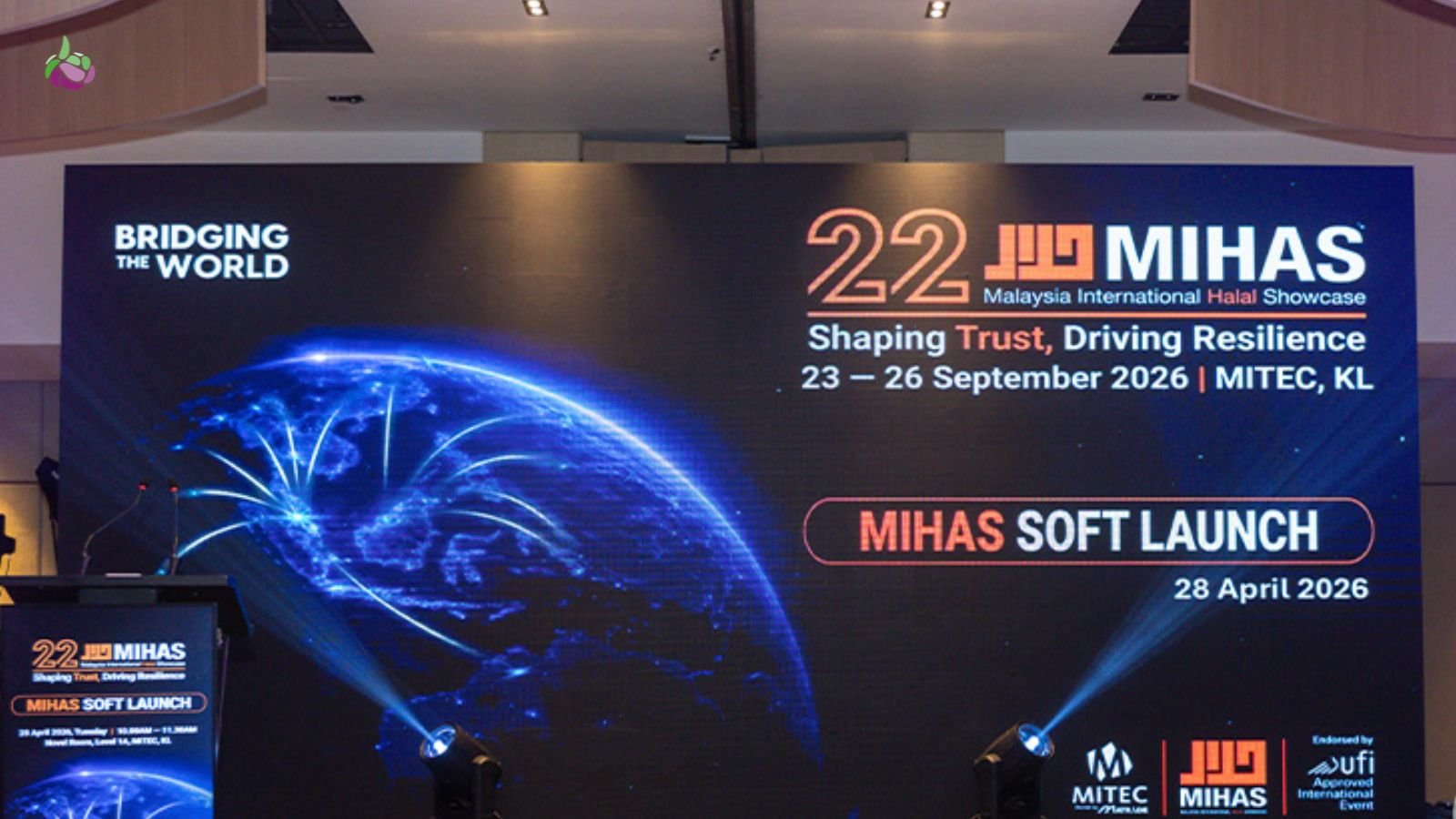
The 22nd Malaysia International Halal Showcase (MIHAS 2026) just wrapped up at MITEC, and our overseas sales team spent four days on the floor talking to importers, private-label buyers, and institutional caterers from across Southeast Asia, the GCC, and beyond. One takeaway was impossible to miss: Halal food has quietly become a global shorthand for health, clean-label integrity, and functional wellness — not just religious compliance.
With the global Halal food economy now surpassing US$2 trillion, we’re seeing a clear shift in what buyers are asking for at the sourcing table. And one raw material kept coming up in almost every conversation we had this year: konjac (Amorphophallus konjac).
As a Halal-, BRC-, IFS-, and HACCP-certified konjac manufacturer with our own planting bases in Sichuan, we wanted to share what we learned at MIHAS this year — and why we think now is the right time for brands to bring a konjac line into their portfolio.
4 Trends We Saw Firsthand at MIHAS 2026
| Driver | What Buyers Told Us |
|---|---|
| 1. The Low-GI / Anti-Sugar Mandate | Rising diabetes prevalence and new sugar taxes across Southeast Asia and the GCC are pushing buyers toward low-carb staples |
| 2. Plant-Based Halal Innovation | Strong demand for gelatin-free gelling agents and texturizers that avoid animal cross-contamination risk entirely |
| 3. Ambient & Dry-Tech Convenience | Buyers want odor-free, shelf-stable formats that cut freight costs — not water-heavy wet packs |
| 4. Full Supply Chain Traceability | JAKIM-aligned Halal documentation plus BRC/IFS/ISO paperwork is now a baseline requirement, not a bonus |
Here’s how konjac answers each of these — and how we’ve built our production around it.
1. Solving the Low-Carb, Low-GI Challenge
Traditional carbohydrate-heavy staples across Southeast Asia and the GCC are colliding with rising rates of diet-related metabolic concerns. Konjac’s natural water-soluble glucomannan (KGM) gives it near-zero net carbs, near-zero calories, and exceptional dietary fiber — making it one of the most credible rice and noodle replacements on the market today. We produce this as Konjac Fine Powder, Shirataki Noodles, and Konjac Rice, formulated to your target Glucomannan content and viscosity specs.
2. A 100% Plant-Based Answer to the Gelatin Problem
For food processors targeting Halal markets, sourcing gelling agents without any risk of animal-derived cross-contamination is a real headache. Konjac gum and konjac-derived hydrocolloids solve this cleanly — no gelatin, no ambiguity. At our booth this year, we walked buyers through applications including:
- Meat & seafood analogues — texture-matched for calamari, crab stick, and plant-based patty formats
- Confectionery & bakery — heat-stable, gelatin-free gelling for jellies, puddings, and functional sauces
3. Dry Konjac Rice: The Format Buyers Actually Want to Talk About
Wet-pack Shirataki noodles are still a solid category, but the real interest at our booth this year was in Dehydrated / Dry Konjac Rice. Compared to liquid-preserved packs, our dry format offers:
- Up to 70% lower international shipping costs (no water weight)
- Zero alkaline/brine odor — customers can boil or blend it directly with conventional rice
- Ambient shelf life, ideal for supermarket private label and meal-prep kit programs
This is where we’re seeing the fastest growth in inbound OEM inquiries right now, and it’s a format we’ve already scaled for several private-label partners.
4. Traceability Isn’t Optional Anymore
Buyers at MIHAS weren’t just asking "are you Halal-certified" — they were asking to see the paper trail from field to finished product. That’s exactly how we built our operation: our own certified konjac planting bases in Sichuan feed directly into our processing lines, so every batch can be traced from planting through primary refining to final extrusion.
What to Look for in a Konjac OEM Partner (Our Honest Take)
We know buyers are comparing multiple suppliers at events like this, so here’s the checklist we’d suggest you run any konjac manufacturer through — including us:
| What to Check | Benchmark to Ask For |
|---|---|
| Halal Certification | Recognized certifying bodies (JAKIM-aligned, MUI, IFANCA) with raw-material-level traceability, not just finished-product sign-off |
| Food Safety Systems | BRCGS, IFS Food, ISO 22000, HACCP, FDA registration |
| Glucomannan Purity | Glucomannan content ≥85–90%, viscosity >30,000 mPa·s, mesh size customizable from 40 to 120 |
| OEM/ODM Flexibility | Can they actually formulate custom recipes — oat-konjac blends, spinach konjac noodles, seasoned instant pots — or just sell you a standard SKU? |
Where Eastern Morning Fits In
We’re Sichuan Eastern Morning Biotechnology Co., Ltd., based in the Anzhou District of Mianyang, Sichuan — one of China’s core konjac-growing regions. A few things about how we work:
- Own planting bases: We don’t just buy raw material on the open market — our certified konjac planting bases give us stable supply, consistent quality, and full farm-to-finished-product traceability.
- 10,000+ m² facility: Automated production lines, cleanroom facilities, and an in-house QC lab, certified to BRC, IFS, HACCP, FDA, and Halal standards.
- 50+ countries served: We’ve built OEM and private-label programs for brands exporting into the US, EU, UK, Japan, and Middle East markets.
- Full product range: Konjac Noodles (Shirataki), Konjac Rice, Konjac Pasta, Konjac Jelly, and functional konjac foods — all available as OEM/ODM with custom formulation, shape, flavor, and packaging.
Let’s Talk at Your Next Sourcing Cycle
If you’re developing a low-carb konjac noodle line, an instant konjac rice SKU, or a functional plant-based formulation for your market, our overseas sales engineering team can put together:
- Product Technical Data Sheets (TDS) and Certificates of Analysis (COA)
- A free B2B sample kit (dry rice, wet noodles, konjac gum)
- A custom private-label OEM/ODM quotation built around your target spec and volume
👉 Contact our team to get started, or explore our full product range.